
Bitcoin Mining Centralization: 51% Attack Risks Explained
Bitcoin Mining Centralization: Understanding the Growing 51% Attack Risk
What is Bitcoin Mining Centralization
Bitcoin mining centralization occurs when a small number of mining pools or entities control a disproportionate share of the network's total hash power. This concentration of mining power fundamentally challenges Bitcoin's decentralized nature and creates potential security vulnerabilities.
The Bitcoin network was designed to be decentralized, with mining power distributed across thousands of individual miners worldwide. However, the evolution of mining technology and the formation of large mining pools have gradually shifted this balance toward centralization.
Understanding 51% Attacks
A 51% attack occurs when a miner or pool of miners accounts for more than half of all mining power, giving them the ability to manipulate the blockchain at will. This type of attack represents one of the most significant theoretical threats to Bitcoin's security model.
When an entity controls more than 50% of the network's hash rate, they gain the power to:
Double-spend transactions
Prevent new transactions from confirming
Reverse completed transactions
Block other miners from mining valid blocks
Current State of Bitcoin Mining Centralization
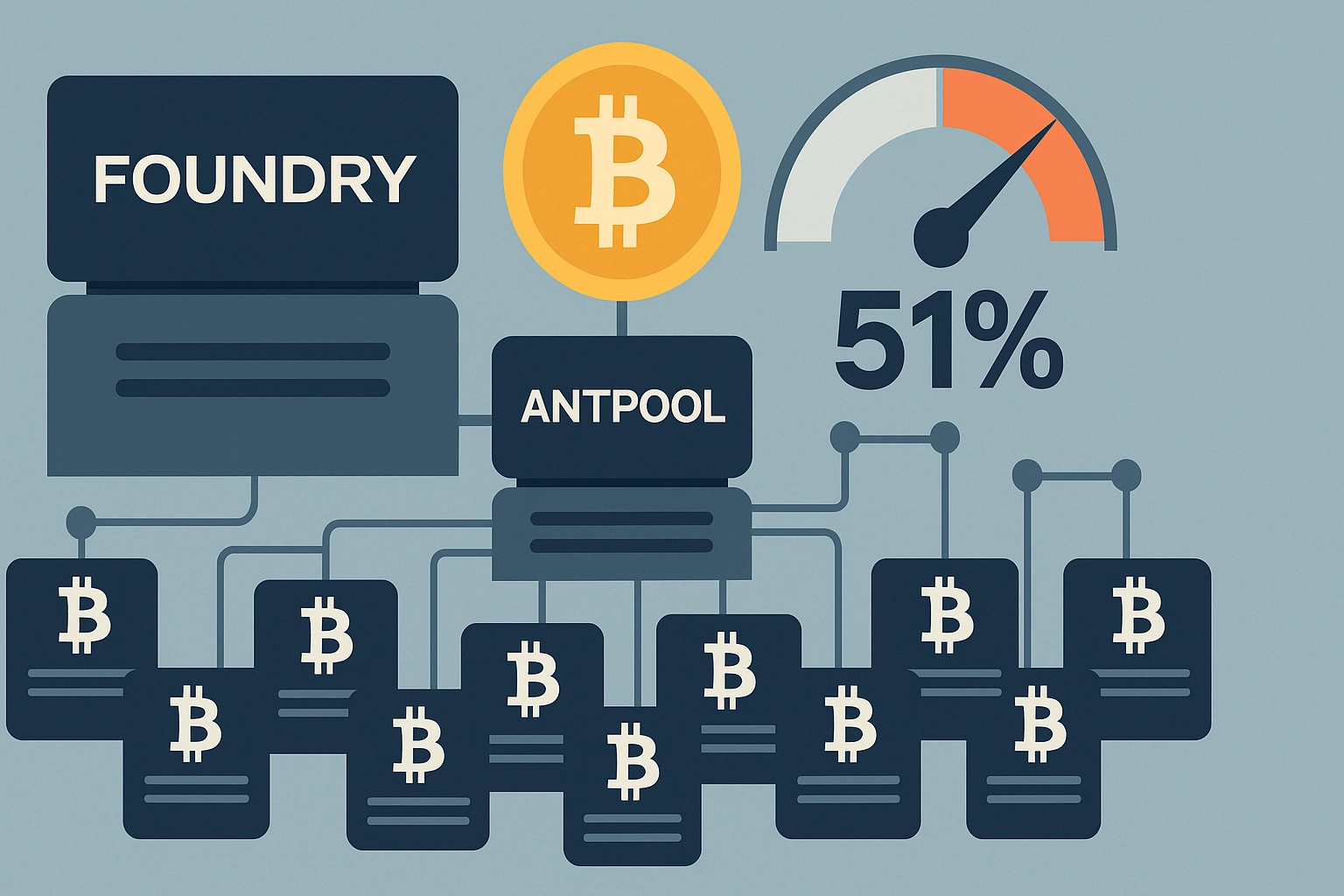
Recent analysis reveals concerning trends in Bitcoin mining concentration. With over 51% of the hash power concentrated in just two entities, experts warn that Bitcoin is technically vulnerable to a 51% attack. This level of concentration represents a significant departure from Bitcoin's original vision of distributed mining power.
The concentration of mining power in a few large pools creates systemic risks that could potentially undermine the entire network's security model. These pools often consist of thousands of individual miners, but the centralized control structure means that pool operators have significant influence over network decisions.
How 51% Attacks Work
The mechanics of a 51% attack involve exploiting the consensus mechanism that secures the Bitcoin network. When attackers control the majority of mining power, they can create a private blockchain fork and eventually make it the longest chain, which other nodes will accept as valid.
If a miner has 40% of the mining power, they have roughly a 50% chance of being able to replace a transaction 5 blocks deep in the chain. This probability increases dramatically as the attacker's hash power approaches or exceeds 51%.
The attack becomes more feasible as fewer confirmations are required to reverse transactions. However, the deeper a transaction is buried in the blockchain, the more expensive and difficult it becomes to reverse.
Economic Implications of Mining Centralization
Mining centralization creates several economic risks for the Bitcoin ecosystem:
Market Confidence: When mining power becomes too concentrated, it can undermine investor confidence and affect Bitcoin's price stability.
Transaction Security: Users may need to wait for more confirmations when centralization risks are high, slowing down transaction processing.
Network Resilience: A centralized mining structure makes the network more vulnerable to regulatory pressure, technical failures, or coordinated attacks.
Real-World Examples and Historical Context
Several cryptocurrencies have already fallen victim to majority attacks, including Monacoin, Bitcoin Gold, and ZenCash. These incidents demonstrate that 51% attacks are not just theoretical threats but real vulnerabilities that have been exploited in practice.
While Bitcoin itself has never experienced a successful 51% attack, there have been instances where mining pools approached dangerous levels of concentration. In 2014, the GHash.io mining pool briefly controlled close to 51% of Bitcoin's hash rate, causing significant concern within the cryptocurrency community.
Technical Defenses Against 51% Attacks
Several technical measures can help mitigate the risk of 51% attacks:
Increased Confirmation Requirements: Requiring more confirmations for large transactions makes attacks more expensive and time-consuming.
Mining Pool Distribution: Encouraging miners to join smaller pools helps distribute hash power more evenly across the network.
Protocol Improvements: Ongoing development of Bitcoin's core protocol includes enhancements designed to make attacks more difficult and expensive.
Geographic Centralization Concerns
Beyond pool centralization, geographic concentration of mining operations presents additional risks. When mining operations cluster in specific regions, they become vulnerable to:
Regulatory crackdowns
Natural disasters
Infrastructure failures
Political instability
This geographic risk adds another layer of centralization concern beyond simple hash power distribution.
The Role of Mining Pools
Mining pools play a crucial role in the centralization discussion. While they allow smaller miners to participate in the network by combining their hash power, they also create points of centralization. Pool operators have significant control over:
Transaction selection
Block creation
Network upgrade decisions
Hash power allocation
Understanding this dynamic is essential for assessing the true level of decentralization in the Bitcoin network.
Future Outlook and Solutions
Many experts are questioning whether the Proof-of-Work mechanism remains suitable to serve as the backbone of the global financial system, with vulnerabilities such as the risk of a 51% attack raising concerns about its long-term viability.
Several potential solutions are being explored:
Decentralized Mining Protocols: New protocols aim to make mining more decentralized by default.
Alternative Consensus Mechanisms: Some propose moving away from Proof-of-Work entirely.
Economic Incentives: Designing systems that economically incentivize decentralization.
Regulatory Frameworks: Developing regulations that promote healthy competition in mining.
Probability Assessment
The chances of a 51% attack on the Bitcoin network are close to zero due to the astounding amount of computing power required, as attackers would need to outcompete millions of bitcoin miners worldwide.
Despite current centralization concerns, executing a successful 51% attack on Bitcoin would require enormous resources and would likely be economically irrational for most actors.
Conclusion
Bitcoin mining centralization represents a significant challenge to the cryptocurrency's founding principles of decentralization. While the immediate risk of a successful 51% attack remains low due to the enormous costs involved, the trend toward centralization requires ongoing monitoring and mitigation efforts.
The Bitcoin community must balance the benefits of mining efficiency with the need to maintain network security and decentralization. Continued vigilance, technical innovation, and community awareness are essential for preserving Bitcoin's security model in the face of evolving centralization pressures.
Understanding these risks helps investors, users, and developers make informed decisions about Bitcoin's future and the measures needed to maintain its security and decentralization over time.
For more Crypto, Web3, Blockchain & AI news visit : www.metamoonmedia.com