
Who Controls Bitcoin Price in 2025: Complete Analysis
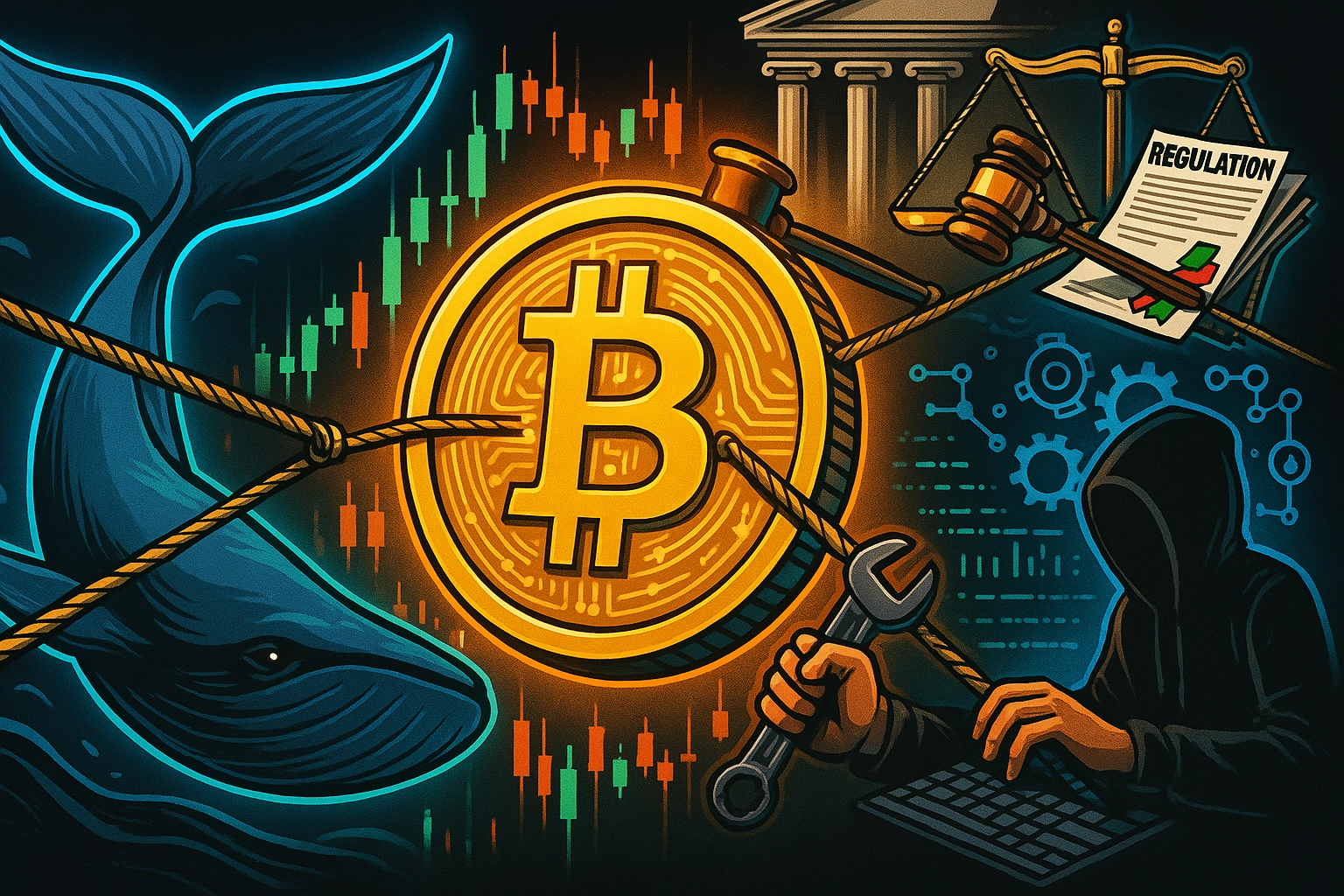
Who Really Controls Bitcoin's Price in 2025: Whales, Developers, or Governments
The question of who controls Bitcoin's price has become increasingly complex as the cryptocurrency market matures. In 2025, the answer isn't straightforward—it's a combination of several key players working in a decentralized ecosystem where influence is distributed and constantly shifting.
How Bitcoin Whales Influence the Market
Bitcoin whales represent the closest thing to market movers in the cryptocurrency space. These large-scale investors, holding thousands of BTC, include institutions, investment funds, and early Bitcoin adopters who accumulated significant positions during the cryptocurrency's early years.
Whale Accumulation Trends in 2025
The number of wallets holding over 1,000 Bitcoin has reached 1,455 as of May 2025, indicating a renewed wave of accumulation among major holders. This growth is primarily driven by institutional players who continue to increase their Bitcoin exposure.
Notable institutional holdings include Strategy, which now controls over 580,000 BTC (approximately 2.76% of the total Bitcoin supply), and BlackRock, which has expanded Bitcoin allocations through its iShares Bitcoin Trust ETF and related investment portfolios.
Combined, these two firms alone control an estimated 6% of the total Bitcoin supply—a significant concentration in an ecosystem designed with fixed issuance and increasingly limited exchange liquidity.
Whale Trading Behavior and Market Impact
Contrary to popular belief, not all Bitcoin whales are long-term holders. Many engage in strategic trading, buying at scale during market downturns and taking profits during strength phases. They often offload their positions precisely when retail investors are entering the market.
Since early 2025, several major market corrections have followed large Bitcoin inflows to exchanges from whale wallets—a pattern that onchain analysts identified as early as February. Conversely, periods of dormancy in whale wallets have coincided with upward price momentum, including Bitcoin's surge past $110,000 in April.
Different Types of Whale Behavior
Data analysis reveals a clear bifurcation in whale behavior. Long-standing whale addresses have realized only $679 million in profits since April, while newer large holders—likely hedge funds and high-net-worth individuals—have taken over $3.2 billion off the table during the same period.
This suggests that early Bitcoin adopters are consolidating their positions for long-term holding, while newer institutional entrants are more inclined to take profits during favorable market conditions.
Developer Influence on Bitcoin Price Through Protocol Upgrades
Bitcoin developers play a crucial role in price movements through protocol upgrades and network improvements. While these upgrades don't occur frequently, they often generate significant market attention and can influence investor sentiment.
SegWit Implementation and Market Response
The Segregated Witness (SegWit) upgrade in August 2017 fundamentally changed how transaction data is stored in Bitcoin blocks, allowing more transactions per block and reducing fees. This upgrade also enabled the development of the Lightning Network for faster, cheaper transactions.
Following SegWit's implementation, Bitcoin experienced a dramatic price surge from approximately $4,000 in August to nearly $20,000 by December 2017. While the broader bull market contributed to this increase, SegWit provided important technical foundations that enhanced Bitcoin's utility.
Taproot Upgrade and Enhanced Functionality
The Taproot upgrade in November 2021 introduced significant improvements to Bitcoin's privacy and efficiency. Complex transactions could now appear as simple ones on the blockchain, improving both privacy and transaction efficiency while enabling more advanced scripting capabilities.
Taproot activated just days after Bitcoin reached its then all-time high of $64,000. The upgrade represented years of development work, with contributions from over 150 developers worldwide, demonstrating the collaborative nature of Bitcoin's development process.
Ordinals and BRC-20 Token Innovation
An unexpected development emerged in 2023-2024 with the introduction of Ordinals and BRC-20 tokens on Bitcoin. Thanks to Taproot's capabilities and creative developer work, users began inscribing data onto individual satoshis, starting with images and evolving into fungible tokens.
This innovation created over $2 billion in market value within months and caused significant increases in miner fees, demonstrating how developer creativity can unlock new use cases and economic activity on the Bitcoin network.
Future Development Prospects
As of May 2025, Bitcoin developers are exploring advanced features like covenants and new opcodes such as OP_CTV and OP_CAT. These potential upgrades could introduce greater flexibility, including vault functionality and programmable spending conditions, potentially expanding Bitcoin's long-term utility.
Bitcoin developer activity has surged in 2025, with over 3,200 commits recorded across repositories in the past year, marking a significant rebound from the 2022 slowdown and signaling renewed momentum in protocol development.
Government Regulation and Bitcoin Price Movements
While no single government controls Bitcoin, regulatory decisions and policy changes have become some of the most significant triggers for major market movements. Government actions shape the environment in which Bitcoin operates, even if they can't directly control the protocol itself.
ETF Approvals and Institutional Adoption
The 2024 approval of spot Bitcoin ETFs in the United States marked a watershed moment for institutional adoption. Multiple funds received regulatory approval, leading to Bitcoin's surge past $73,000 as billions of dollars flowed through platforms like BlackRock's IBIT.
The ETF approval process demonstrated how regulatory clarity can unlock institutional capital and drive significant price appreciation through increased accessibility and legitimacy.
Regulatory Uncertainty and Market Reactions
Conversely, regulatory uncertainty can create significant market volatility. The European Union's proposals to tighten surveillance on self-custodial wallets created market anxiety in 2023 and 2024, as investors worried about privacy restrictions and potential barriers to cryptocurrency adoption.
These regulatory concerns led to temporary market pullbacks, reflecting investor sensitivity to policy changes that could affect Bitcoin's accessibility or utility.
Macroeconomic Policy Impact
Bitcoin's price remains sensitive to broader macroeconomic policies, particularly monetary policy decisions by major central banks. When the US Federal Reserve paused interest rate hikes in late 2023 and indicated potential rate cuts in 2024, Bitcoin responded positively.
Lower interest rates typically increase liquidity in financial markets, weaken the US dollar, and boost appetite for alternative assets like Bitcoin, demonstrating the cryptocurrency's correlation with broader financial conditions.
Resilience Against Restrictive Policies
Despite various government restrictions, Bitcoin has demonstrated remarkable resilience. China's ongoing restrictions on trading and mining haven't eliminated demand, as users continue accessing Bitcoin through over-the-counter desks, VPNs, and offshore platforms.
Surprisingly robust OTC volumes in China during 2025 highlight the difficulty of enforcing borders around a technology designed to be borderless and resistant to centralized control.
The Reality of Bitcoin Price Control in 2025
The truth about Bitcoin price control is that it operates as a decentralized system where multiple factors interact simultaneously. No single entity or group maintains complete control over Bitcoin's price movements.
Multiple Influencing Factors
Bitcoin's price reflects a complex interplay of various forces:
Whale Activity: Large holders continue to move significant volume, especially during periods of low liquidity, but their influence varies depending on market conditions and overall trading activity.
Protocol Development: Developers shape Bitcoin's underlying technology, creating the foundation for new use cases and improved functionality that can influence long-term value perception.
Regulatory Environment: Government actions add pressure or provide permission through regulation, taxation, and enforcement policies that affect market access and institutional adoption.
Macroeconomic Conditions: Interest rates, inflation, and dollar strength set the broader risk appetite that influences how investors view Bitcoin relative to other assets.
Beyond the Headlines
Several additional factors contribute to Bitcoin's price dynamics beyond the primary influencers:
Market sentiment plays a crucial role, with retail euphoria capable of creating parabolic price runs while institutional caution can trigger sharp retreats. Social narratives, from artificial intelligence hype to global instability concerns, now significantly influence how Bitcoin is positioned in investment portfolios.
Real-World Examples from 2025
The dynamic nature of Bitcoin price control has been evident throughout 2025:
Spot ETF approvals brought record capital inflows but didn't always result in sustained price rallies, demonstrating that even positive regulatory developments don't guarantee immediate price appreciation.
Regulatory crackdowns in specific regions were often offset by growth and adoption in other areas, showing the global nature of Bitcoin markets and their resistance to localized restrictions.
Whale movements triggered less market panic during calmer market conditions, suggesting that context matters significantly in how the market interprets large holder behavior.
Some of the biggest price surges occurred due to narrative momentum alone, without corresponding fundamental developments, highlighting the importance of market psychology and sentiment.
Understanding Bitcoin's Decentralized Price Discovery
Bitcoin's price mechanism represents a unique form of decentralized price discovery that differs fundamentally from traditional assets. Rather than being controlled by a single entity or small group, Bitcoin's value emerges from the continuous interaction of global participants.
The Paradox of Influence Without Control
Bitcoin embodies a fascinating paradox: it operates as a decentralized system while remaining susceptible to various forms of influence. The cryptocurrency reflects collective belief, behavior, and ongoing negotiation between users, developers, institutions, and regulators worldwide.
Price as Market Pulse
Bitcoin's price functions less as a definitive verdict on value and more as a real-time pulse of market confidence, uncertainty, and conviction. It tracks the collective assessment of Bitcoin's utility, adoption prospects, regulatory environment, and macroeconomic context.
Conclusion: Shared Influence in a Decentralized System
In 2025, Bitcoin's price control represents a complex web of shared influence rather than centralized authority. Whales, developers, and governments each play important roles, but none maintains complete control over price movements.
The cryptocurrency's value emerges from the dynamic interaction of technical development, institutional adoption, regulatory clarity, market sentiment, and broader economic conditions. This decentralized approach to price discovery, while creating volatility and uncertainty, also provides resilience against single points of failure or control.
Understanding Bitcoin's price dynamics requires recognizing that multiple forces operate simultaneously, sometimes reinforcing each other and sometimes working in opposition. This complexity makes Bitcoin fascinating as both a technological innovation and a financial asset, reflecting the broader trend toward decentralized systems in the digital economy.
For more Crypto, Web3, Blockchain & AI news visit : www.metamoonmedia.com