
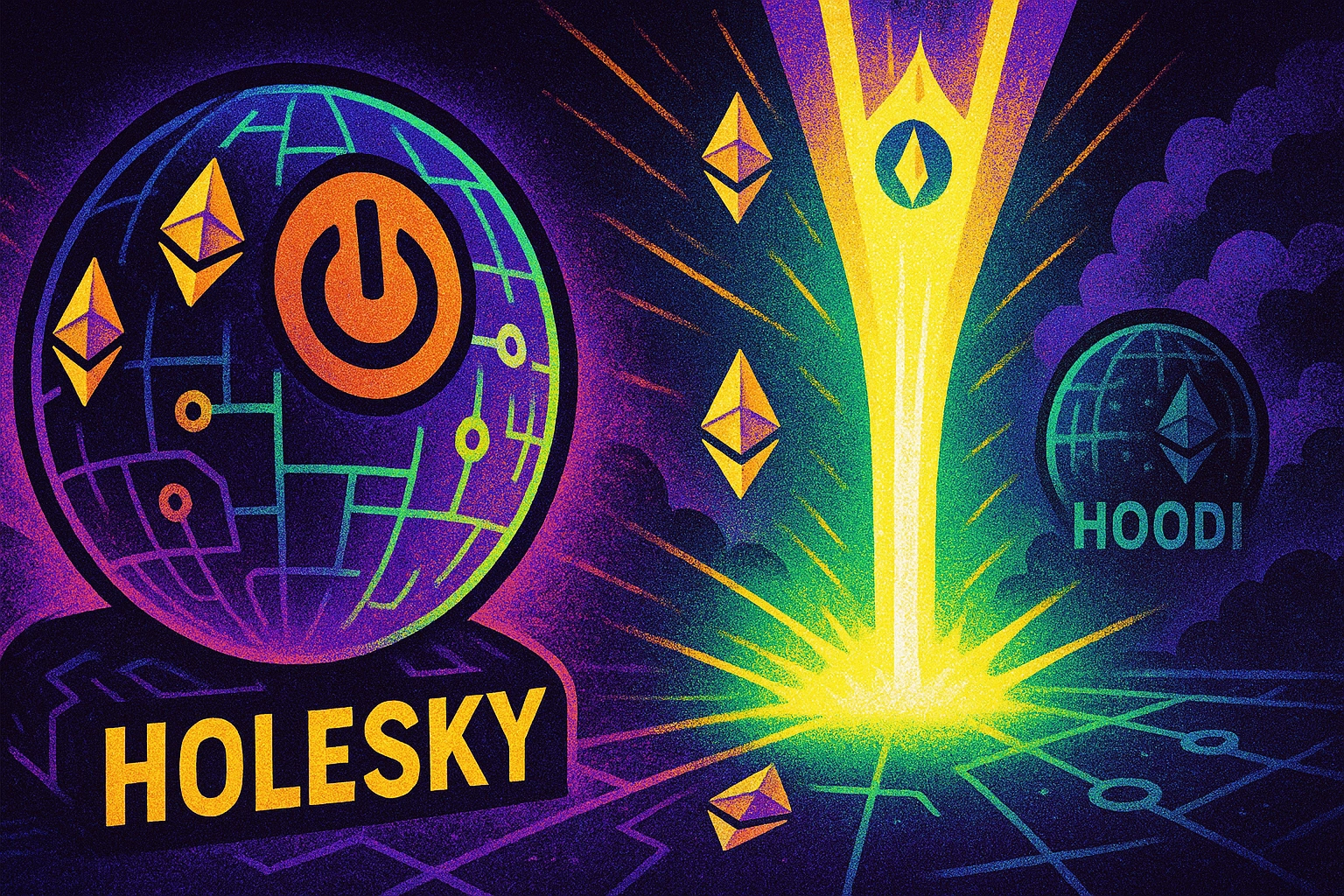
Ethereum Holesky Testnet Shutdown After Fusaka Fork
Ethereum Shuts Down Holesky Testnet Following Fusaka Upgrade
Ethereum's largest testnet, Holesky, is set to shut down as part of a planned migration to the new Hoodi testnet. The shutdown comes after several technical challenges and represents a strategic move to improve Ethereum's testing infrastructure.
Holesky Testnet Shutdown Timeline
The Ethereum Foundation announced that Holesky will be shut down two weeks after the Fusaka upgrade is finalized on the network. The upgrade is scheduled for the second half of September, with the mainnet launch planned for November 2025.
After the shutdown, Holesky will no longer receive support from client, testing, or infrastructure teams. This marks the end of a successful testing phase that began when Holesky launched in September 2023.
Holesky's Purpose and Achievements
Holesky was specifically designed to test staking infrastructure and validator operations. During its operational period, the testnet successfully enabled thousands of validators to test critical protocol upgrades, including:
The Dencun network upgrade
The recent Pectra upgrade
Various staking mechanism improvements
The testnet served its intended purpose by providing a robust environment for testing Ethereum's proof-of-stake infrastructure before implementing changes on the mainnet.
Technical Challenges and Recovery
Despite its success, Holesky experienced significant technical issues in early 2025. The network suffered from extensive inactivity leaks, resulting in a large validator exit queue. While the testnet eventually recovered from these issues, the problems highlighted the need for a fresh testing environment.
These technical difficulties prompted the Ethereum Foundation to launch the Hoodi testnet in March 2025, providing developers and validators with a clean testing environment free from the legacy issues affecting Holesky.
Migration to Hoodi Testnet
The transition from Holesky to Hoodi represents a strategic upgrade in Ethereum's testing infrastructure. Hoodi already supports the Pectra update and is prepared to activate future protocol upgrades, including the upcoming Fusaka fork.
Key benefits of migrating to Hoodi include:
Fresh testing environment without legacy issues
Full support for current and future protocol upgrades
Improved stability and performance
Better resource allocation for testing teams
All staking operators and infrastructure previously using Holesky will need to migrate to Hoodi to continue their testing operations.
Alternative Testing Options
For developers focused on smart contract and decentralized application testing, the Ethereum Foundation recommends using Sepolia as the primary testnet. Sepolia provides a stable environment specifically optimized for application development and smart contract deployment testing.
Fusaka Upgrade Details
The Fusaka hard fork, combining Fulu and Osaka upgrades, is scheduled for early November 2025. This significant upgrade aims to improve how rollups access data by distributing data availability workloads more efficiently across network validators.
Expected improvements from Fusaka include:
Easier node operation requirements
Enhanced network decentralization
Improved layer-2 scalability
Faster transaction processing for rollups
Lower transaction costs across the network
The upgrade will implement 11 Ethereum Improvement Proposals, representing one of the most comprehensive updates to the Ethereum network.
Future Ethereum Developments
Beyond Fusaka, Ethereum has additional upgrades planned for the coming years. The Glamsterdam upgrade, scheduled for 2026 under EIP-7782, proposes to halve block times from 12 seconds to 6 seconds.
This future upgrade would separate block validation from execution, giving provers more time to craft zero-knowledge Ethereum Virtual Machine proofs. This change could significantly improve transaction throughput and network efficiency.
Market Impact and Adoption
Ethereum's continuous development and improvement efforts are reflected in market adoption. Several publicly listed companies have established Ether treasuries in recent months, contributing to Ethereum's strong price performance with over 200% growth since April 2025.
These developments demonstrate the cryptocurrency community's confidence in Ethereum's long-term technical roadmap and its ability to scale effectively while maintaining decentralization.
Conclusion
The shutdown of Holesky testnet marks an important milestone in Ethereum's development process. While the testnet successfully served its purpose for nearly two years, the migration to Hoodi represents Ethereum's commitment to continuous improvement and optimization of its testing infrastructure.
The planned shutdown, combined with the upcoming Fusaka upgrade, positions Ethereum for enhanced scalability and improved user experience in 2026 and beyond. Developers and validators should prepare for the migration to ensure continued access to Ethereum's testing capabilities.
For more Crypto, Web3, Blockchain & AI news visit : www.metamoonmedia.com